Mar 19, 2014
Dragonfall is probably the best CRPG (and game, given that it's my fav genre)
I've played in a few years.
Right mix of setting, world, characters, tone, choices and mechanics, and it
only gets more amazing towards the end.
I think
all the praise it gets is well deserved - for me it's up there with
early Bioware games (BGs, PST) and Fallouts.
Didn't quite expect it too after okay'ish Dead Man's Switch first SRR
experience, and hopefully there's more to come from HBS, would even justify
another kickstarter imo.
Nov 05, 2013
So my laptop broke anyway, but on the bright side - I've got fairly large
(certainly by my display standards) desktop fullhd screen now.
While restoring OS there, decided to update ~/.conkyrc (see conky), as it was
kinda small for this larger screen, so why not put some eye-candy there, while
at it?
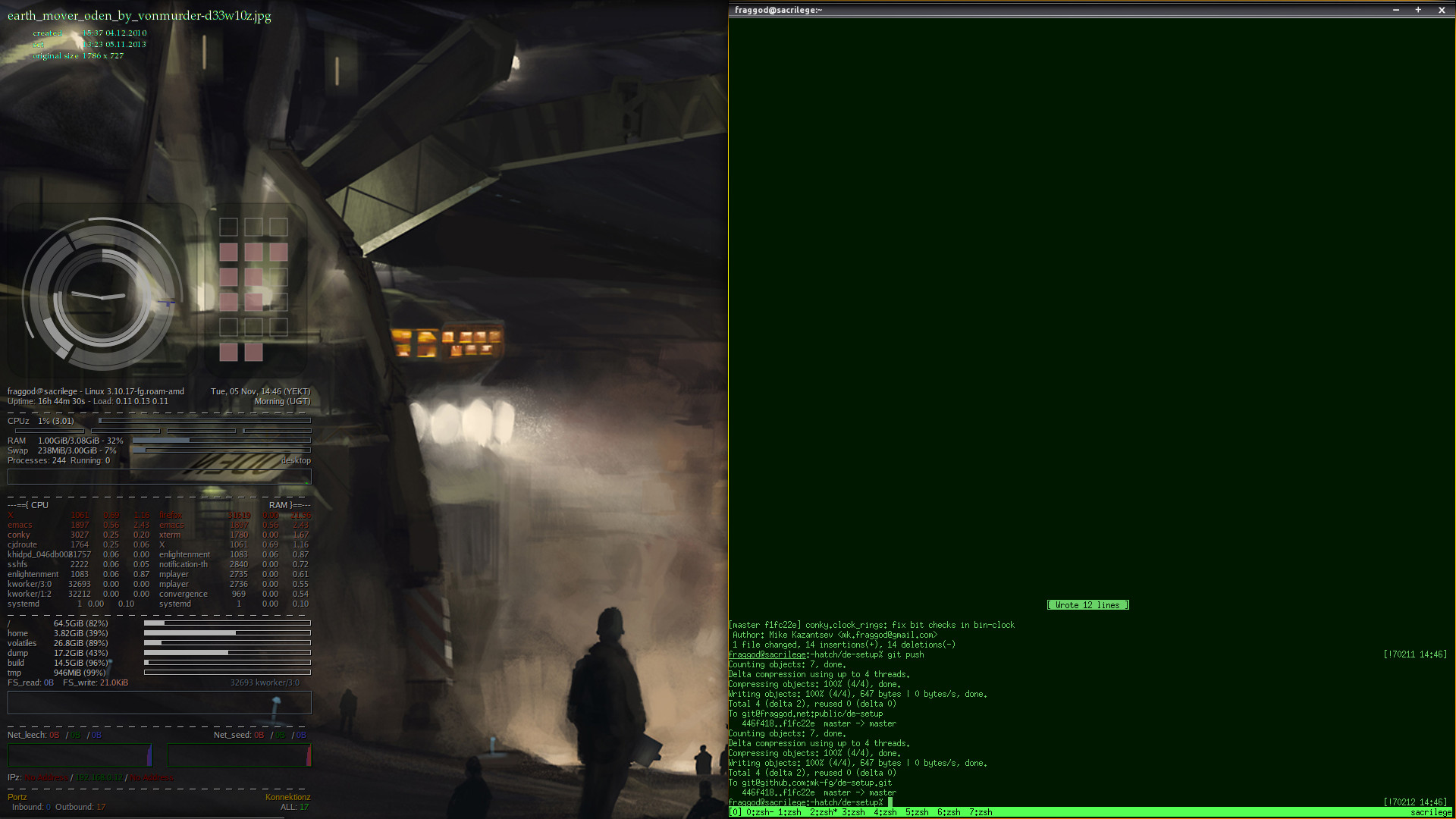
Leftmost radial meters show (inner-to-outer) clock with hands and rings right
next to them, blue-ish cpu arcs (right-bottom, outer one is load summary, inner
ones are per-core), used (non-cache) memory/swap (left), network traffic
(top-right, green/red arcs for up/down) and / and /home df arcs (outer top).
On the right it's good ol' binary clock.
All drawings are lua script, all text and graphs below is conky's magic.
Whole script to draw the things can be found in de-setup repo on gh along
with full conkyrc I currently use.
Nov 01, 2013
Had a fan in a laptop dying for a few weeks now, but international mail being
universally bad (and me too hopeful about dying fan's lifetime), replacement
from ebay is still on its looong way.
Meanwhile, thing started screeching like mad, causing strong vibration in the
plastic and stopping/restarting every few seconds with an audible thunk.
Things not looking good, and me being too lazy to work hard enough to be able to
afford new laptop, had to do something to postpone this one's imminent death.
Cleaning the dust and hairs out of fan's propeller and heatsink and changing
thermal paste did make the thing a bit cooler, but given that it's fairly slim
Acer S3 ultrabook, no local repair shop was able to offer any immediate
replacement for the fan, so no clean hw fix in reach yet.
Interesting thing about broken fans though, is that they seem to start vibrating
madly out of control only beyond certain speed, so one option was to slow the
thing down, while keeping cpu cool somehow.
cpupower tool that comes with linux kernel can nicely downclock this i5 cpu to
800 MHz, but that's not really enough to keep fan from spinning madly - some
default BIOS code seem to be putting it to 100% at 50C.
Besides, from what I've seen, it seem to be quite counter-productive, making
everything (e.g. opening page in FF) much longer, keeping cpu at 100% of that
lower rate all the time, which seem to heat it up slower, sure, but to the same
or even higher level for the same task (e.g. opening that web page), with side
effect being also wasting time.
Luckily, found out that fan on Acer laptops can be controlled using /dev/ports
registers, as described on
linlap wiki page.
50C doesn't seem to be high for these CPUs at all, and one previous laptop
worked fine on 80C all the time, so making threshold for killing the fan
higher seem to be a good idea - it's not like there's much to loose anyway.
As acers3fand script linked from the wiki was for a bit different purpose,
wrote my own (also lighter and more self-contained) script - fan_control to
only put more than ~50% of power to it after it goes beyond 60C and warns if it
heats up way more without putting the fan into "wailing death" mode ever, with
max being at about 75% power, also reaching for cpupower hack before that.
Such manual control opens up a possibility of cpu overheating though, or
otherwise doesn't help much when you run cpu-intensive stuff, and I kinda don't
want to worry about some cronjob, stuck dev script or hung DE app killing the
machine while I'm away, so one additional hack I could think of is to just
throttle CPU bandwidth enough so that:
- short tasks complete at top performance, without delays.
- long cpu-intensive stuff gets throttled to a point where it can't generate
enough heat and cpu stays at some 60C with slow fan speed.
- some known-to-be-intensive tasks like compilation get their own especially
low limits.
So kinda like cpupower trick, but more fine-grained and without fixed presets
one can slow things down to (as lowest bar there doesn't cut it).
Kernel Control Groups (cgroups) turned out to have the right thing for that -
"cpu" resource controller there has cfs_quote_us/cfs_period_us knobs to control
cpu bandwidth for threads within a specific cgroup.
New enough systemd has the concept of "slices" to control resources for a
groups of services, which are applied automatically for all DE stuff as
"user.slice" and its "user-<name>.slice" subslices, so all that had to be done
is to echo the right values (which don't cause overheating or fan-fail) to
that rc's /sys knobs.
Similar generic limitations are easy to apply to other services there by
grouping them with Slice= option.
For distinct limits on daemons started from cli, there's "systemd-run" tool
these days, and for more proper interactive wrapping, I've had pet
cgroup-tools scripts for a while now (to limit cpu priority of heavier bg
stuff like builds though).
With that last tweak, situation seem to be under control - no stray app can
really kill the cpu and fan doesn't have to do all the hard work to prevent it
either, seemingly solving that hardware fail with software measures for now.
Keeping mobile i5 cpu around 50 degrees apparently needs it to spin only
barely, yet seem to allow all the desktop stuff to function without noticeable
slowdowns or difference.
Makes me wonder why Intel did allow that low-power ARM things fly past it...
Now, if only replacement fan got here before I drop off the nets even with these
hacks.
Sep 26, 2013
Wrote a driver for still common FAT32 recently, while solving the issue with
shuffle on cheap "usb stick with microsd slot" mp3 player.
It's kinda amazing how crappy firmware in these things can be.
Guess one should know better than to get such crap with 1-line display, gapful
playback, weak battery, rewind at non-accelerating ~3x speed, no ability to pick
tracks while playing and plenty of other annoying "features", but the main issue
I've had with the thing by far is missing shuffle functionality - it only plays
tracks in static order in which they were uploaded (i.e. how they're stored on
fs).
Seems like whoever built the thing made it deliberately hard to shuffle the
tracks offline - just one sort by name would've made things a lot easier, and
it's clear that device reads the full dir listing from the time it spends
opening dirs with lots of files.
Most obvious way to do such "offline shuffle", given how the thing orders files,
is to re-upload tracks in different order, which is way too slow and wears out
flash ram.
Second obvious for me was to dig into FAT32 and just reorder entries there,
which is what the script does.
It's based off example of a simpler fat16 parser in construct module repo
and processes all the necessary metadata structures like PDRs, FATs (cluster
maps) and directory tables with vfat long-name entries inside.
Given that directory table on FAT32 is just an array (with vfat entries linked
to dentries after them though), it's kinda easy just to shuffle entries there
and write data back to clusters from where it was read.
One less obvious solution to shuffle, coming from understanding how vfat lfn
entries work, is that one can actually force fs driver to reorder them by
randomizing filename length, as it'll be forced to move longer entries to the
end of the directory table.
But that idea came a bit too late, and such parser can be useful for extending
FAT32 to whatever custom fs (with e.g. FUSE or 9p interface) or implementing
some of the more complex hacks.
It's interestng that fat dentries can (and apparently known to) store unix-like
modes and uid/gid instead of some other less-useful attrs, but linux driver
doesn't seem to make use of it.
OS'es also don't allow symlinks or hardlinks on fat, while technically it's
possible, as long as you keep these read-only - just create dentries that point
to the same cluster.
Should probably work for both files and dirs and allow to create multiple
hierarchies of the same files, like several dirs where same tracks are
shuffled with different seed, alongside dirs where they're separated by
artist/album/genre or whatever other tags.
It's very fast and cheap to create these, as each is basically about
"(name_length + 32B) * file_count" in size, which is like just 8 KiB for dir
structure holding 100+ files.
So plan is to extend this small hack to use mutagen to auto-generate such
hierarchies in the future, or maybe hook it directly into beets as an export
plugin, combined with transcoding, webui and convenient music-db there.
Also, can finally tick off "write proper on-disk fs driver" from "things to do
in life" list ;)
Aug 08, 2013
Most advice wrt encryption on a remote hosts (VPS, VDS) don't seem to involve
full-disk encryption as such, but is rather limited to encrypting /var and
/home, so that machine will boot from non-crypted / and you'll be able to ssh to
it, decrypt these parts manually, then start services that use data there.
That seem to be in contrast with what's generally used on local machines - make
LUKS container right on top of physical disk device, except for /boot (if it's
not on USB key) and don't let that encryption layer bother you anymore.
Two policies seem to differ in that former one is opt-in - you have to actively
think which data to put onto encrypted part (e.g. /etc/ssl has private keys?
move to /var, shred from /etc), while the latter is opt-out - everything is
encrypted, period.
So, in spirit of that opt-out way, I thought it'd be a drag to go double-think
wrt which data should be stored where and it'd be better to just go ahead and
put everything possible to encrypted container for a remote host as well,
leaving only /boot with kernel and initramfs in the clear.
Naturally, to enter encryption password and not have it stored alongside LUKS
header, some remote login from the network is in order, and sshd seem to be
the secure and easy way to go about it.
Initramfs in question should then also be able to setup network, which luckily
dracut can. Openssh sshd is a bit too heavy for it though, but there are much
lighter sshd's like
dropbear.
Searching around for someone to tie the two things up, found a bit incomplete
and non-packaged solutions like this RH enhancement proposal and a set of
hacky scripts and instructions in dracut-crypt-wait repo on bitbucket.
Approach outlined in RH bugzilla is to make dracut "crypt" module to operate
normally and let cryptsetup query for password in linux console, but also
start sshd in the background, where one can login and use a simple tool to
echo password to that console (without having it echoed).
dracut-crypt-wait does a clever hack of removing "crypt" module hook instead
and basically creates "rescure" console on sshd, where user have to manually
do all the decryption necessary and then signal initramfs to proceed with the
boot.
I thought first way was rather more elegant and clever, allowing dracut to
figure out which device to decrypt and start cryptsetup with all the necessary,
configured and documented parameters, also still allowing to type passphrase
into console - best of both worlds, so went along with that one, creating
dracut-crypt-sshd project.
As README there explains, using it is as easy as adding it into dracut.conf (or
passing to dracut on command line) and adding networking to grub.cfg, e.g.:
menuentry "My Linux" {
        linux /vmlinuz ro root=LABEL=root
                rd.luks.uuid=7a476ea0 rd.lvm.vg=lvmcrypt rd.neednet=1
                ip=88.195.61.177::88.195.61.161:255.255.255.224:myhost:enp0s9:off
        initrd /dracut.xz
}
("ip=dhcp" might be simpler way to go, but doesn't yield default route in my case)
And there, you'll have sshd on that IP port 2222 (configurable), with
pre-generated (during dracut build) keys, which might be a good idea to put into
"known_hosts" for that ip/port somewhere. "authorized_keys" is taken from
/root/.ssh by default, but also configurable via dracut.conf, if necessary.
Apart from sshd, that module includes two tools for interaction with console -
console_peek and console_auth (derived from auth.c in the bugzilla link above).
Logging in to that sshd then yields sequence like this:
[214] Aug 08 13:29:54 lastlog_perform_login: Couldn't stat /var/log/lastlog: No such file or directory
[214] Aug 08 13:29:54 lastlog_openseek: /var/log/lastlog is not a file or directory!

# console_peek
[    1.711778] Write protecting the kernel text: 4208k
[    1.711875] Write protecting the kernel read-only data: 1116k
[    1.735488] dracut: dracut-031
[    1.756132] systemd-udevd[137]: starting version 206
[    1.760022] tsc: Refined TSC clocksource calibration: 2199.749 MHz
[    1.760109] Switching to clocksource tsc
[    1.809905] systemd-udevd[145]: renamed network interface eth0 to enp0s9
[    1.974202] 8139too 0000:00:09.0 enp0s9: link up, 100Mbps, full-duplex, lpa 0x45E1
[    1.983151] dracut: sshd port: 2222
[    1.983254] dracut: sshd key fingerprint: 2048 0e:14:...:36:f9  root@congo (RSA)
[    1.983392] dracut: sshd key bubblebabble: 2048 xikak-...-poxix  root@congo (RSA)
[185] Aug 08 13:29:29 Failed reading '-', disabling DSS
[186] Aug 08 13:29:29 Running in background
[    2.093869] dracut: luksOpen /dev/sda3 luks-...
Enter passphrase for /dev/sda3:
[213] Aug 08 13:29:50 Child connection from 188.226.62.174:46309
[213] Aug 08 13:29:54 Pubkey auth succeeded for 'root' with key md5 0b:97:bb:...

# console_auth
Passphrase:

#
First command - "console_peek" - allows to see which password is requested (if
any) and second one allows to login.
Note that fingerprints of host keys are also echoed to console on sshd start,
in case one has access to console but still needs sshd later.
I quickly found out that such initramfs with sshd is also a great and robust
rescue tool, especially if "debug" and/or "rescue" dracut modules are enabled.
And as it includes fairly comprehensive network-setup options, might be a good
way to boot multiple different OS'es with same (machine-specific) network
parameters,
Probably obligatory disclaimer for such post should mention that crypto above
won't save you from malicious hoster or whatever three-letter-agency that will
coerce it into cooperation, should it take interest in your poor machine - it'll
just extract keys from RAM image (especially if it's a virtualized VPS) or
backdoor kernel/initramfs and force a reboot.
Threat model here is more trivial - be able to turn off and decomission host
without fear of disks/images then falling into some other party's hands, which
might also happen if hoster eventually goes bust or sells/scraps disks due to
age or bad blocks.
Also, even minor inconvenience like forcing to extract keys like outlined above
might be helpful in case of quite well-known "we came fishing to a datacenter,
shut everything down, give us all the hardware in these racks" tactic employed
by some agencies.
Absolute security is a myth, but these measures are fairly trivial and practical
to be employed casually to cut off at least some number of basic threats.
So, yay for dracut, the amazingly cool and hackable initramfs project, which
made it that easy.
Code link: https://github.com/mk-fg/dracut-crypt-sshd
Jun 09, 2013
I've been using Hyperboria darknet for about a month now, and after late influx
of russian users there (after this article) got plently of peers, so node is
forwarding a bit of network traffic.
Being a dorknet-proper, of course, you can't see what kind of traffic it is or
to whom it goes (though cjdns doesn't have anonymity as a goal), but I thought
it'd be nice to at least know when my internet lags due to someone launching DoS
flood or abusing torrents.
Over the Internet (called "clearnet" here), cjdns peers using udp, but linux
conntrack seem to be good enough to track these "connections" just as if they
were stateful tcp flows.
Simple-ish traffic accounting on vanilla linux usually boils down to ulogd2,
which can use packet-capturing interfaces (raw sockets via libpcap, netfilter
ULOG and NFLOG targets), but it's kinda heavy-handed here - traffic is opaque,
only endpoints matter, so another one of its interfaces seem to be better
option - conntrack tables/events.
Handy conntrack-tools (or /proc/net/{ip,nf}_conntrack) cat track all the
connections, including simple udp-based ones (like cjdns uses), producing
entries like:
udp 17 179 \
        src=110.133.5.117 dst=188.226.51.71 sport=52728 dport=8131 \
        src=188.226.51.71 dst=110.133.5.117 sport=8131 dport=52728 \
        [ASSURED] mark=16 use=1
First trick is to enable the packet/byte counters there, which is a simple, but
default-off sysctl knob:
# sysctl -w net.netfilter.nf_conntrack_acct=1
That will add "bytes=" and "packets=" values there for both directions.
Of course, polling the table is a good way to introduce extra hangs into system
(/proc files are basically hooks that tend to lock stuff to get consistent
reads) and loose stuff in-between polls, so luckily there's an event-based
netlink interface and ulogd2 daemon to monitor that.
One easy way to pick both incoming and outgoing udp flows in ulogd2 is to add
connmarks to these:
-A INPUT -p udp --dport $cjdns_port -j CONNMARK --set-xmark 0x10/0x10
-A OUTPUT -p udp --sport $cjdns_port -j CONNMARK --set-xmark 0x10/0x10
Then setup filtering by these in ulogd.conf:
...

stack=log:NFCT,mark:MARK,ip2str:IP2STR,print:PRINTFLOW,out:GPRINT

[log]
accept_proto_filter=udp

[mark]
mark=0x10
mask=0x10

[out]
file="/var/log/ulogd2/cjdns.log"
Should produce parseable log of all the traffic flows with IPs and such.
Fairly simple script can then be used to push this data to graphite, munin,
ganglia, cacti or whatever time-series graphing/processing tool.
Linked script is for graphite "carbon" interface.
Jun 06, 2013
Wanted to share three kinda-big-deal fixes I've added to my firefox:
- Patch to remove sticky-on-top focus-grabbing "Do you want to activate plugins
on this page?" popup.
- Patch to prevent plugins (e.g. Abode Flash) from ever grabbing firefox
hotkeys like "Ctrl + w" (close tab) or F5, forcing to do click outside
e.g. YouTube video window to get back to ff.
- Easy "toggle js" fix for JavaScript on pages grabbing controls like keyboard
and mouse (e.g. overriding F5 to retweet instead of reload page, preventing
copy-paste if forms and on pages, etc).
Lately, firefox seem to give more-and-more control into the hands of web
developers, who seem to be hell-bent on abusing that to make browsing UX a
living hell.
FF bug-reports about Flash grabbing all the focus date back to 2001 and are
unresolved still.
Sites override Up/Down, Space, PgUp/PgDown, F5, Ctrl+T/W I've no idea why -
guess some JS developers just don't use keyboard at all, which is somewhat
understandable, combined with the spread of tablet-devices these days.
Overriding clicks in forms to prevent pasting email/password seem to be
completely ignoring valid (or so I think) use-case of using some storage app
for these.
And native "click-to-play" switch seem to be hilariously unusable in FF, giving
cheerful "Hey, there's flash here! Let me pester you with this on every page
load!" popups.
All are known, neither one seem to be going away anytime soon, so onwards to the
fixes.
Removing "Do you want to activate plugins" thing seem to be straightforward js
one-liner patch, as it's implemented in
"browser/base/content/browser-plugins.js" - whole fix is adding
this._notificationDisplayedOnce = true; to break the check there.
"notificationDisplayedOnce" thing is used to not popup that thing on the same
page within the same browing session afaict.
Patch for plugin focus is clever - all one has to do is to switch focus to
browser window (from embedded flash widget) before keypress gets processed and
ff will handle it correctly.
Hackish plugin + ad-hoc perl script solution (to avoid patching/rebuilding ff)
can be found
here.
My hat goes to Alexander Rødseth however, who hacked the patch attached to
ff-bug-78414 - this one is a real problem-solver, though a bit (not
terribly - just context lines got shuffled around since) out-of-date.
JS-click/key-jacking issue seem to require some JS event firewalling, and
sometimes (e.g. JS games or some weird-design sites) can be useful.
So my solution was simply to bind JS-toggle key, which allows not only to
disable all that crap, but also speed some "load-shit-as-you-go" or
JS-BTC-mining (or so it feels) sites rapidly.
var prefs = Components.classes['@mozilla.org/preferences-service;1']
    .getService(Components.interfaces.nsIPrefBranch),
  state = prefs.getBoolPref('javascript.enabled');
prefs.setBoolPref('javascript.enabled', !state);
That's the whole thing, bound to something like Ctrl+\ (the one above Enter
here), makes a nice "Turbo and Get Off My JS" key.
Fairly sure there are addons that allow to toggle prefs ("javascript.enabled"
above) via keys without needing any code, but I have this one.
Damn glad there are open-source (and uglifyjs-like) browsers like that, hope
proprietary google-ware won't take over the world in the nearest future.
Mentioned patches are available in (and integrated with-) the firefox-nightly
exheres in my repo, forked off awesome sardemff7-pending
firefox-scm.exheres-0 / mozilla-app.exlib work.
Apr 29, 2013
I've tried both of these in the past, but didn't have attention budget to make
them really work for me - which finally found now, so wanted to also give
crawlers a few more keywords on these nice things.
0bin - leak-proof pastebin
As I pastebin a lot of stuff all the time - basically everything multiline -
because all my IM happens in ERC over IRC (with bitlbee linking xmpp and all
the proprietary crap like icq, skype and twitter), and IRC doesn't handle
multiline messages at all.
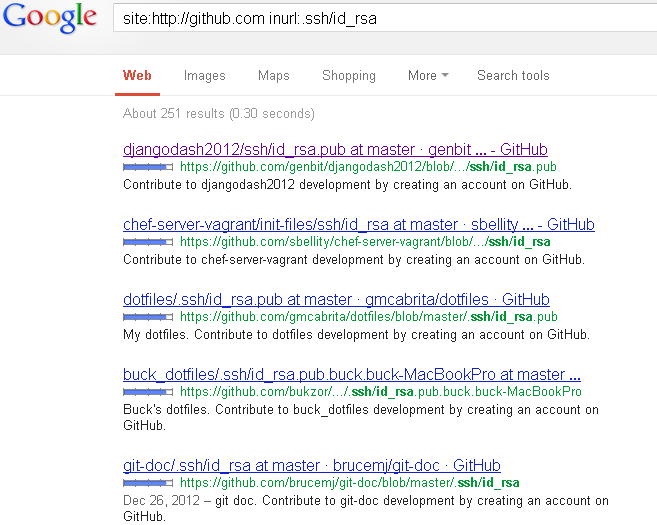
All sorts of important stuff ends up there - some internal credentials,
contacts, non-public code, bugs, private chat logs, etc - so I always winced a
bit when pasting something in fear that google might index/data-mine it and
preserve forever, so I figured it'll bite me eventually, somewhat like this:
Easy and acceptable solution is to use simple client-side crypto, with link
having decryption key after hashmark, which never gets sent to pastebin server
and doesn't provide crawlers with any useful data. ZeroBin does that.
But original ZeroBin is php, which I don't really want to touch, and have its
share of problems - from the lack of command-line client (for e.g. grep stuff
log | zerobinpaste), to overly-long urls and flaky overloaded interface.
Luckily, there's more hackable python version of it - 0bin, for which I hacked
together a simple zerobinpaste tool, then simplified interface to bare
minimum and updated to use shorter urls (#41, #42) and put to my host -
result is paste.fraggod.net - my own nice robot-proof pastebin.
URLs there aren't any longer than with regular pastebins:
http://paste.fraggod.net/paste/pLmEb0BI#Verfn+7o
Plus the links there expire reliably, and it's easy to force this expiration,
having control over app backend.
Local fork should have all the not-yet-merged stuff as well as the
non-upstreamable simpler white-bootstrap theme.
Convergence - better PKI for TLS keys
Can't really recommend this video highly enough to anyone with even the
slightest bit of interest in security, web or SSL/TLS protocols.
There are lots of issues beyond just key distribution and authentication, but
I'd dare anyone to watch that rundown of just-as-of-2011 issues and remain
convinced that the PKI there is fine or even good enough.
Even fairly simple
Convergence tool implementation is a vast improvement,
giving a lot of control to make informed decisions about who to trust on the
net.
I've been using the plugin in the past, but eventually it broke and I just
disabled it until the better times when it'll be fixed, but Moxie seem to have
moved on to other tasks and project never got the developers' attention it
deserved.
So finally got around to fixing fairly massive list of issues around it
myself.
Bugs around newer firefox plugin were the priority - one was compatibility thing
from PR #170, another is endless hanging on all requests to notaries (PR
#173), more minor issues with adding notaries, interfaces and just plain bugs
that were always there.
Then there was one shortcoming of existing perspective-only verification
mechanism that bugged me - it didn't utilize existing flawed CA lists at all,
making decision of whether random site's cert is signed by at least some
crappy CA or completely homegrown (and thus don't belong on
e.g. "paypal.com").
Not the deciding factor by any means, but allows to make much more informed
decision than just perspectives for e.g. fishing site with typo in URL.
So was able to utilize (and extend a bit) the best part of Convergence - agility
of its trust decision-making - by hacking together a verifier (which can be
easily run on desktop localhost) that queries existing CA lists.
Enabling Convergence with that doesn't even force to give up the old model -
just adds perspective checks on top, giving a clear picture of which of the
checks have failed on any inconsistencies.
Other server-side fixes include nice argparse interface, configuration file
support, loading of verifiers from setuptools/distribute entry points (can be
installed separately with any python package), hackish TLS SNI support (Moxie
actually filed twisted-5374 about more proper fix), sane logging, ...
Filed only a few PR for the show-stopper client bugs, but looks like upstream
repo is simply dead, pity ;(
But all this stuff should be available in
my fork in the meantime.
Top-level README there should provide a more complete list of links and
changes.
Hopefully, upstream development will be picked-up at some point, or maybe
shift to some next incarnation of the idea -
CrossBear seem to potentially
be one.
Until then, at least was able to salvage this one, and hacking ctypes-heavy ff
extension implementing SOCKS MitM proxy was quite rewarding experience all by
itself... certainly broadens horizons on just how damn accessible and simple
it is to implement such seemingly-complex protocol wrappers.
Plan to also add a few other internet-observatory (like OONI, CrossBear crawls,
EFF Observatory, etc) plugins there in the near future, plus some other things
listed in the README here.
Apr 24, 2013
Was hacking on (or rather debugging) Convergence FF plugin and it became
painfully obvious that I really needed something simple to push js changes from
local git clone to ~/.mozilla so that I can test them.
Usually I tend to employ simple ad-hoc for src in $(git st | awk ...); do cat
$src >... hack, and done same thing in this case as well, but was forgetting
to run it after small "debug printf" changes waaay too often.
At this point, I sometimes hack some ad-hoc emacs post-save hook to run the
thing, but this time decided to find some simpler and more generic "run that on
any changes to path" tool.
Until the last few years, the only way to do that was polling or inotify, and
for some project dir it's actually quite fine, but luckily there's fanotify in
kernel now, and fatrace looks like the simliest cli tool based on it.
# fatrace
sadc(977): W /var/log/sa/sa24
sadc(977): W /var/log/sa/sa24
sadc(977): W /var/log/sa/sa24
sadc(977): W /var/log/sa/sa24
qmgr(1195): O /var/spool/postfix/deferred
qmgr(1195): CO /var/spool/postfix/deferred/0
qmgr(1195): CO /var/spool/postfix/deferred/3
qmgr(1195): CO /var/spool/postfix/deferred/7
...
That thing can just watch everything that's being done to all (or any
specific) local mount(s).
Even better - reports the app that does the changes.
I never got over auditd's complexity for such simple use-cases, so was damn
glad that there is a real and simpler alternative now.
Unfortunately, with power of the thing comes the need for root, so one simple
bash wrapper later, my "sync changes" issue was finally resolved:
(root) ~# fatrace_pipe ~user/hatch/project
(user) project% xargs -in1 </tmp/fatrace.fifo make
Looks like a real problem-solver for a lot of real-world "what the hell happens
on the fs there!?" cases as well - can't recommend the thing highly-enough for
all that.
Apr 08, 2013
As discordian folk celebrated Jake Day yesterday, decided that I've had it
with random hanging userspace state-machines, stuck forever with tcp connections
that are not legitimately dead, just waiting on both sides.
And since pretty much every tool can handle transient connection failures and
reconnects, decided to come up with some simple and robust-enough solution to
break such links without (or rather before) patching all the apps to behave.
One last straw was davfs2 failing after a brief net-hiccup, with my options
limited to killing everything that uses (and is hanging dead on) its mount,
then going kill/remount way.
As it uses stateless http connections, I bet it's not even an issue for it to
repeat whatever request it tried last and it sure as hell handles network
failures, just not well in all cases.
I've used such technique to test some twisted-things in the past, so it was easy
to dig scapy-automata code for doing that, though the real trick is not to
craft/send FIN or RST packet, but rather to guess TCP seq/ack numbers to stamp
it with.
Alas, none of the existing tools (e.g. tcpkill) seem to do anything clever in
this regard.
cutter states that
There is a feature of the TCP/IP protocol that we could use to good effect
here - if a packet (other than an RST) is received on a connection that has
the wrong sequence number, then the host responds by sending a corrective
"ACK" packet back.
But neither the tool itself nor the technique described seem to work, and I
actually failed to find (or recall) any mentions (or other uses) of such
corrective behavior. Maybe it was so waaay back, dunno.
Naturally, as I can run such tool on the host where socket endpoint is, local
kernel has these numbers stored, but apparently no one really cared (or had a
legitimate enough use-case) to expose these to the userspace... until very
recently, that is.
Recent work of Parallels folks on
CRIU landed
getsockopt(sk, SOL_TCP,
TCP_QUEUE_SEQ, ...) in one the latest mainline kernel releases.
Trick is then just to run that syscall in the pid that holds the socket fd,
which looks like a trivial enough task, but looking over
crtools (which
unfortunately doesn't seem to work with vanilla kernel yet) and
ptrace-parasite tricks of compiling and injecting shellcode, decided that
it's just too much work for me, plus they share the same x86_64-only codebase,
and I'd like to have the thing working on ia32 machines as well.
Caching all the "seen" seq numbers in advance looks tempting, especially since
for most cases, relevant traffic is processed already by
nflog-zmq-pcap-pipe and
Snort, which can potentially dump
"(endpoint1-endpoint2, seq, len)" tuples to some fast key-value backend.
Invalidation of these might be a minor issue, but I'm not too thrilled about
having some dissection code to pre-cache stuff that's already cached in every
kernel anyway.
Patching kernel to just expose stuff via /proc looks like bit of a burden as
well, though an isolated module code would probably do the job well.
Weird that there doesn't seem to be one of these around already, closest one
being tcp_probe.c code, which hooks into tcp_recv code-path and doesn't really
get seqs without some traffic either.
One interesting idea that got my attention and didn't require a single line of
extra code was proposed on the local xmpp channel - to use tcp keepalives.
Sure, they won't make kernel drop connection when it's userspace that hangs on
both ends, with connection itself being perfectly healthy, but every one of
these carries a seq number that can be spoofed and used to destroy that
"healthy" state.
Pity these are optional and can't be just turned on for all sockets system-wide
on linux (unlike some BSD systems, apparently), and nothing uses these much by
choice (which can be seen in netstat --timer).
Luckily, there's a dead-simple LD_PRELOAD code of
libkeepalive which can be
used to enforce system-wide opt-out behavior for these (at least for
non-static binaries).
For suid stuff (like mount.davfs, mentioned above), it has to be in
/etc/ld.so.preload, not just env, but as I need it "just in case" for all the
connections, that seems fine in my case.
And tuning keepalives to be frequent-enough seem to be a no-brainer and
shouldn't have any effect on 99% of legitimate connections at all, as they
probably pass some traffic every other second, not after minutes or hours.
net.ipv4.tcp_keepalive_time = 900
net.ipv4.tcp_keepalive_probes = 5
net.ipv4.tcp_keepalive_intvl = 156
(default is to send empty keepalive packet after 2 hours of idleness)
With that, tool has to run ~7 min on average to kill any tcp connection in the
system, which totally acceptable, and no fragile non-portable ptrace-shellcode
magic involved (at least yet, I bet it'd be much easier to do in the future).
Code and some docs for the tool/approach can be found on github.
More of the same (update 2013-08-11):
Actually, lacking some better way to send RST/FIN from a machine to itself than
swapping MACs (and hoping that router is misconfigured enough to bounce packet
"from itself" back) or "-j REJECT --reject-with tcp-reset" (plus a "recent"
match or transient-port matching, to avoid blocking reconnect as well),
countdown for a connection should be ~7 + 15 min, as only next keepalive will
reliably produce RST response.
With a bit of ipset/iptables/nflog magic, it was easy to make the one-time
REJECT rule, snatching seq from dropped packet via NFLOG and using that to
produce RST for the other side as well.
Whole magic there goes like this:
-A conn_cutter ! -p tcp -j RETURN
-A conn_cutter -m set ! --match-set conn_cutter src,src -j RETURN
-A conn_cutter -p tcp -m recent --set --name conn_cutter --rsource
-A conn_cutter -p tcp -m recent ! --rcheck --seconds 20\
        --hitcount 2 --name conn_cutter --rsource -j NFLOG
-A conn_cutter -p tcp -m recent ! --rcheck --seconds 20\
        --hitcount 2 --name conn_cutter --rsource -j REJECT --reject-with tcp-reset

-I OUTPUT -j conn_cutter
"recent" matcher there is a bit redundant in most cases, as outgoing connections
usually use transient-range tcp ports, which shouldn't match for different
attempts, but some apps might bind these explicitly.
ipset turned out to be quite a neat thing to avoid iptables manipulations (to
add/remove match).
It's interesting that this set of rules handles RST to both ends all by itself
if packet arrives from remote first - response (e.g. ACK) from local socket will
get RST but won't reach remote, and retransmit from remote will get RST because
local port is legitimately closed by then.
Current code allows to optionally specify ipset name, whether to use nflog
(via spin-off scapy-nflog-capture driver) or raw sockets, and doesn't do any
mac-swapping, only sending RST to remote (which, again, should still be
sufficient with frequent-enough keepalives).
Now, if only some decade-old undocumented code didn't explicitly disable these
nice keepalives...